Posts

Showing posts with the label History

Core RAM =/= Core ROM
Image
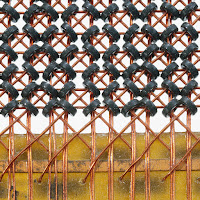
They work using completely different principles. Core RAM used ferrite cores as the bits , with the wires used to magnetize the cores in opposing directions (clockwise vs counterclockwise; '1' vs' '0'). (Little memory moment here - the ferrite cores would break and fall on the floor.  Your sysadmin would sweep up the detritus, and put it in the bit-bucket . (see?  there was a literal explanation!!!) Core ROM uses ferrite cores as transformers, with the wires themselves being the bits .  The ferrite core would be used to induce a current (or not!) in a second wire based on whether there was a current in the first wire (if the second wire was wrapped around the core too, the current would be induced.  If it wasn't wrapped, no current.  See?  '1' vs '0'! (Mind you, you could, theoretically , flip a bit by moving/rewrapping a wire!) To think this is the stuff that got people to the moon and back :-)

Adam was from Cameroon!!! (aka: "The Y Chromosome World Map")

Image
Check out this map of the genetic diversity of the Y chromosome (basically, how it migrated through the world) (via Wikipedia ) Interesting info from the above : Adam came from Cameroon based on the A0 and A00 haplogroup The predominant Greek haplogroup (E) is most commonly found in Africa (remember, Greeks are "white", whatever that means) Continuing on "whiteness", the predominant European haplogroup (R) is also all over west/central Africa And Egypt is a mix of European and African haplogroups, which pretty much makes sense 'cos thats pretty much where everybody had to go through to get out of Africa and go anywhere (and vice-versa!)  

Mexican-origin and the USA - a (somewhat depressing) #Visualization

Image
From The Economist , On February 2nd 1848 [...] An area covering most of present-day Arizona, California, Nevada, New Mexico and Utah, plus parts of several other states, was handed over to  gringolandia . The rebellious state of Tejas, which had declared its independence from Mexico in 1836, was recognised as American soil too. But a century and a half later, communities have proved more durable than borders. The counties with the highest concentration of Mexicans (as defined by ethnicity, rather than citizenship) overlap closely with the area that belonged to Mexico before the great gringo land-grab of 1848. Some are recent arrivals; others trace their roots to long before the map was redrawn. They didn’t jump the border—it jumped them. For a history of the Mexican (as part of the wider Hispanic) experience in America, I can't recommend Felipe Fernández-Armesto's book Our America: A Hispanic History of the United States  highly enough. He is a Spanish historian at Th...

100 Years of Rock and Roll - a #Visualization in less than a Minute

Image
The title pretty much sez. it all. Its interactive, and the slices of music are an inspired touch.

Transcontinental Air Travel - a #Visualization (from 1929)

Image
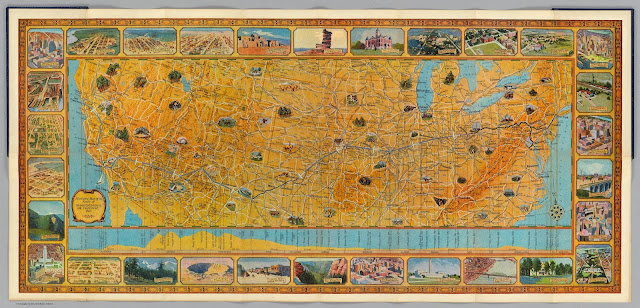
From  Slate - a scan of an old souvenir fold-out map, given to passengers going cross-country via Transcontinental Air Transport  (TAT) in 1929. From the site Despite the company’s name, the trip was not quite transcontinental—as you can see on this map, passengers took a train to Columbus, Ohio, then another from  Waynoka, Okla . to Clovis, N.M. In between, they flew in  Ford Tri-Motor planes  with a capacity of 10 to 12 passengers and wicker seats. Passengers  flew by day  so they could see the sights and  slept on the trains at night . The map’s borders feature scenes of the American landscape, showing places that the passengers could expect to see from the ground (Clovis’ main street) and from the air (the campus of the University of Missouri, Los Angeles’ new City Hall). The trip took 48 hours altogether in ideal conditions. David Rumsey  notes  that on the back of this map, Mason Menefee, the passenger who owned it, f...

The History of English Puddings - Visualized

Image
J Homersham wades through the entire history of English Puddings . Why? I don't really know, but we are the better of for it.  Mind you, if you want to know more (a lot more), you're probably better off reading the relevant entry on Food Timeline which contains such gems as Botellum sic facies: sex ovi vitellis coctis, nucleis pineis concisei cepam, porrum concisum, ius crudum misces, piper minutum et sic intestinum farcies. Adidies liquamen et vinum et sic coques (from Apicus in Ancient Rome, roughly translated to "Blood sausage is made as follows: 6 hard-boiled egg yolks, finely chopped pine kernels mixed with onion, finely sliced leek. Mix raw blood with finely ground pepper and fill a pig's intestine with this. Add wine and liquamen and cook. (Ap. 55) Anyhow, heres the pictorial history (click to embiggen)

San Francisco Street History - Visualized

Image
Noah Veltman does yeoman's work in wading through the history of most SF Street Names - complete w/ Wiki links, interactivity, and whatnot. e.g., Did you know that Howard is named after William Davis Merry Howard , who was not only not a Brandybuck, but was " A sailor and early settler who served on San Francisco's first city council. He was also involved in the formation of the Committee of Vigilance in 1851. " The below is just an image, go here for the original interactive version hat-tip Nathan Yau

The Financial Crisis Was Foreseeable … Thousands of Years Ago

Image
From The Big Picture , more evidence that the financial crisis was entirely, and completely, foreseeable . We’ve known for   4,000 years   that debts need to be periodically written down, or the entire economy will collapse. And see   this . We’ve known for   2,500 years   that prolonged war bankrupts an economy. We’ve known for   1,900 years   that rampant inequality destroys societies. We’ve known for   thousands of years   that debasing currencies leads to economic collapse. We’ve known for   hundreds of years   that the failure to punish financial fraud destroys economies, as it destroys all trust in the financial system. We’ve known for   hundreds of years   that monopolies and the political influence which accompanies too much power in too few hands is dangerous for free markets. We’ve known for   centuries   that companies will try to pawn their debts off on governments, and that it is ...

The history of Rock n' Roll (in 100 Riffs)

Image
From Alex, at the Chicago Music Exchange