Saturday, March 30, 2013

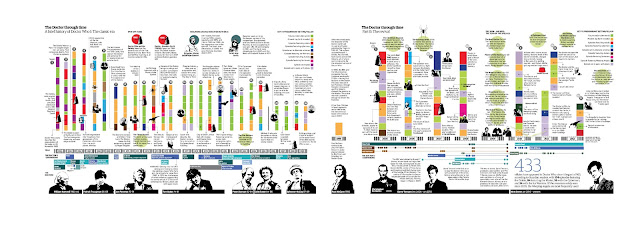
50 Years of Doctor Who - Visualized

The Guardian is - quite possibly - the leader in "Data Visualization as Journalism", and their take on the Doctor through the years is no exception.  This work by their designer Kari Pederson is comprehensive and spectacular. Click the below to embiggen (a lot), or better, go here for the pdf)

Coffee - (un)intuitively Visualized

From Nathan Yau comes this breakdown of the ingredients in whatever this East London coffee shop is selling.
WTF?
Seriously, WTF?
How are we supposed to know what these are? Maybe red is water, and green is an espresso shot?
I guess the whole thing is a bit of an a-la carte thing, but you'd hope that there would be something that sez. "This is a latte, that, is a macchiato" etc.
 Then again, maybe that is the point, and we're supposed to guess...

Thursday, March 28, 2013

Porn Stars and Careers - Visualized

What happens when you spend 6 months analyzing 10,000 porn stars and their careers?  Well, apart from creating what is arguably the easiest setup line in the history of setup lines, you also end up with a trove of data, and one massive infographic, and some fairly surprising statistics such as the most common hair color (brown)

The most common female role (Teen, followed by MILF)

The most common names (Nikki Lee and David Lee. Why? No clue...)

and a whole bunch more
Anyhow, the infographic is located here (its huge, so I'm not going to bother embedding it)

Monday, March 25, 2013

Irrational Nonsense - Visualized

Crispin Jago wades through the crapfest of irrational nonsense, and pulls it all together into a neat - and startling - Venn Diagram.  My favorite bit is what is at the intersection of it all :-)
However as such nonsensical beliefs continue to evolve they become more and more fanciful and eventually creep across the bollock borders. Although all the items depicted on the diagram are completely bereft of any form of scientific credibility, those that successfully intersect the sets achieve new heights of implausibility and ridiculousness. And there is one belief so completely ludicrous it successfully flirts with all forms of bollocks.

Religious Bollocks ∩ Quackery Bollocks ∩ Pseudoscientific Bollocks ∩ Paranormal Bollocks = Scientology
Click to embiggen quite a bit

Tuesday, March 19, 2013

"Learn You Some Erlang For Great Good" - a review thereof

Disclaimer #1 - I was asked to review this book, and no starch press sent me a review copy.
Disclaimer #2 - The erlang world is somewhat small, and I happen to know the author.
Disclaimer #3 - I helped proof-read large swathes of the book. (Ok, that one isn't a disclaimer - it was an #AutoPlug. Sue me).

When you really get down to it, books tend to come in two types
  1. Reference Books : These are the ones that you pick up when you want to learn something, or more likely, when you need to look something up.  The classic example, of course, is The Camel Book (to me at least.  I find perl to be quite useful, and the perfect counterpoint to erlang)
  2. Fun to Read Books : These are the ones that you read 'cos, well, they're fun.  Anything by Jasper Fforde, Iain Banks, or Terry Pratchett counts. 
And yeah, the intersection between categories (1) and (2) is basically the null set.  Mind you, if your idea of entertainment is curling up in front of the fireplace w/ a glass of sherry and Volume 3 of Knuth, well, I have no time for you...

Then again, that's not quite fair because now, now, there actually is a book which is not just a brilliant reference book for erlang, but is also an unalloyed pleasure, and definitely fun to read.

It is Fred Hebert's Learn You Some Erlang For Great Good.

I know, I know, "c'est impossible".  A fun to read book on Programming?  Not just any old type of programming mind you, but erlang? With its syntax issues? And all that functional cruft? And no NullPointerException the way god intended?
To which, I can only say, "non, c'est possible".

Its insightful, its witty, its charming, and it has what appears to be a mutant squid on the cover - five reasons to go get the book(*).

Come to think of it, this is - by far - the most accessible take on erlang that I have seen in a long long time.
Ok, ever.
Take the section on Common Test.  You could go read the original docs, which contain such deeply insightful statements as
In a black-box testing scenario, CT based test programs connect to the target system(s) via standard O&M and CLI protocols
which, no doubt, meant a great deal to someone, but face it, its not exactly scintillating dinner-time conversation (**).
Fred, on the other hand, has actually managed to make Common Test not just understandable, but accessible to boot. (Personal bias here - I don't get why more people don't use CT - it is a heck of a lot easier to work with than EUnit).  The classic line in the book is, in my opinion, from this chapter, and goes
Oh what the hell did Common Test do to my beautiful directory? It is a shameful thing to look at.
Which is both funny, and absolutely true (Use Common Test.  Then go look at the directory.  Then read the line again.  Seriously)

Anyhow, the book has it all.  And I do mean all.  Its got chapters on everything from ETS through Exceptions, syntax through supervisors, and pretty much any other alliterative (or not) thing involving erlang that you can think of.
Or not think of.
As far as I can tell, about the only reason Fred stopped writing was that he ran out of things to write about -which should clue you in that this is a big book (***).

All that being said, probably the best part about the book is that it takes you through virtually everything you need to know about not just erlang, but the underlying context/philosophy associated with erlang, viz., developing reliable and fault-tolerant applications and systems.  And that, my friend, is well worth the price of admission.

So, go get the book, read it, and enjoy.
If you haven't heard of it before, you're welcome.
If you have, and haven't bought the book yet, why not? Just Do It...
 
(*) - Yes, I can count. The fifth reason is Surprise...
(**) - It is, however, extremely important. Trust me.
(***) - 624 pages. That is a lot of big...

Monday, March 18, 2013

The Sun - Visualized

The Guardian pulls together some information from NASA to show us the myriad ways in which they look at the Sun - Surface movement, Magnetic field polarity, Coronal flares, and oh so much more.
Its visually brilliant (heh, a pun), and awe-inspiring.
Click on each to embiggen

The world according to Indians - Visualized

via Siddharth Singh (hat-tip Ajay Bhardwaj)
I'm a particular fan of the Canada-ization of Nepal ("The 29th State"), though Switzerland ("Shah Rukh Khan dances here") is a close second :-)

Friday, March 15, 2013

John Snow's Cholera Map - Visualized (again!)

Remember John Snow? The Cholera guy? The dude who pretty much invented epidemiology?  In case you don't, and didn't check out the Wikipedia link above, he mapped out the incidence of cholera during an outbreak in 1854, and based on the pattern, deduced that (being clustered around the Broad Street public water pump) cholera was spread by contaminated water.

That map is now justifiably famous - and is the one you see to the right (embiggen for its full glory)

The folks at The Guardian (who are constantly brilliant at this sort of stuff) have recreated the map using the original data and CartoDB.  I've embedded a screen-grab below, but go to their site for the original.
Mapping tools have certainly become quite awesome, no?


Tuesday, March 12, 2013

Billy Joel can still bring it - who knew?

Billy sing "New York State Of Mind" with Vanderbilt University student Michael Pollack, filmed during "An Evening of Questions and Answers and a Little Bit of Music" at the university in January 2013.
Hes great, and Michael Pollack, well, is pretty awesome too...


hat tip Bob Lefsetz

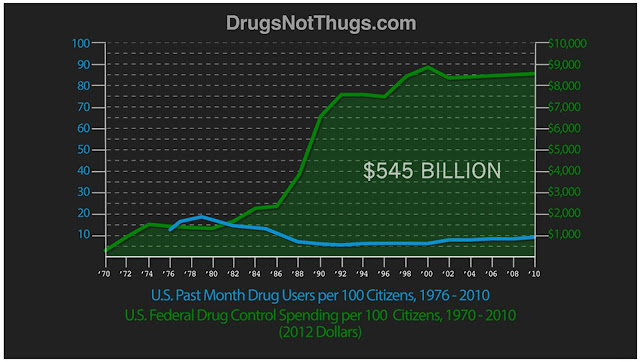
The War on Drugs - Visualized

 Matt Groff puts together a chart showing Drug users vs (anti) Drug spending - per 100 citizens.
There does seem to be a wee bit of controversy around this, but the basic point is pretty well made.
(The above is but a screen-capture. Go check out the original)

Thursday, March 7, 2013

Household Net Worth by Race - Depressing

Pew research finds (and the census backs up) this ridiculously depressing piece of data
The median wealth of white households is 20 times that of black households and 18 times that of Hispanic households, according to a Pew Research Center analysis of newly available government data from 2009.
These lopsided wealth ratios are the largest since the government began publishing such data a quarter century ago and roughly twice the size of the ratios that had prevailed between these three groups for the two decades prior to the Great Recession that ended in 2009.
I really have nothing else to add to this.
Sigh.

Wednesday, March 6, 2013

Commute times in NYC - Visualized

It turns out that the US Census does something called the American Community Survey, which provides statistics on all sorts of stuff for pretty much every community in the US (yes. Including Tuscaloosa)
One of these is the "Out of State and Long Commutes" survey, which has such delightful factoids as
23.0 percent of workers with long commutes (60 minutes or more) use public transit, compared with 5.3 percent for all workers. Only 61.1 percent of workers with long commutes drove to work alone, compared with 79.9 percent for all workers who worked outside the home.
Anyhow, WNYC took this data and mapped it for NYC (well, d-uh), and the results are below.  The bottom line? Manhattan is - not surprisingly - extraordinarily commuter friendly.  I suspect mass-transit :-)

c

Tuesday, March 5, 2013

Papal Probabilities - Visualized

Fascinated by the papal election?
Interested in the minutiae of the curia?
Or maybe you're just wondering who gets to ride around next in the popemobile?
Never fear, DataParadigms has the Pope Probability Tracker set up for you, all nice and shiny, with code on github and all.  As they put it
Last week, I set up a scrapper to update the odds hourly from a prominent bookmaker. Given that I had a weeks worth of data, it was time to fire up iPython and see the action.
The betting lines seem to have stabilized over the last few days. As we get closer and closer to papal conclave and the members of the remaining Cardinal electors arrive in Rome, the lines should show some movement..
The result is below (go to the original for the up-to-date info).
And yes, I read "Angelo Scola" as "Anthony Scalia", and it scared the pants off of me too...

Monday, March 4, 2013

Baby Elephant + Ocean = Cute


That is all...