Monday, February 25, 2013
Saturday, February 23, 2013
Cannonball Tree!
Spotted this one just outside the Ravindra Kalakshetra in Bangalore. Its called the Cannonball Tree, but is - technically (i.e., in Latin, if thats your metier) - Couroupita Guianensis, or ನಾಗಲಿಂಗ ಪುಷ್ಪಾ in Kannada.
The fruits look like Cannonballs (well, d-uh), and the flowers are really quite amazing, and pretty ludicrously distinctive...
Friday, February 22, 2013
NYC Tweets by Language - Visualized
Ed Manley and James Chesire analyze tweets from NYC, and the results pretty much point out the polyglot nature of New York.
From their description
(The below is an image - go here to see the interactive version)
From their description
English (in grey above) is by far the most popular with Spanish (in blue above) taking the top spot amongst the other language groups. Portuguese and Japanese take third and fourth respectively. Midtown Manhattan and JFK International Airport have, perhaps unsurprisingly, the most linguistically diverse tweets whilst specific languages shine through in places such as Brighton Beach (Russian), the Bronx (Spanish) and towards Newark (Portuguese). You can also spot international clusters on Liberty Island and Ellis Island and if you look carefully the tracks of ferry boats between them. Ed has written up some more in depth analysis of the data here.Mind you, nobody seems to be tweeting in Kannada :-)
(The below is an image - go here to see the interactive version)
Wednesday, February 20, 2013
NASA - the sequel
Yup.
That pretty much sums up our approach towards NASA.
Actually, pretty much anything related to the gummint, come to think of it...
(via Jon @ Scenes from a Multiverse)
That pretty much sums up our approach towards NASA.
Actually, pretty much anything related to the gummint, come to think of it...
(via Jon @ Scenes from a Multiverse)
Coffee Shops in NYC - Visualized
Every wondered what the distribution of coffee shops in NYC looks like?
Well, StatsBee does the heavy lifting so that you don't have to, and the results should surprise absolutely no-one that lives in NYC. From the column
(Click to embiggen. A lot)In order to figure out where StatsBee readers could warm up, we used the latestRestaurant Inspection Results from the New York City Department of Health and Mental Hygiene. When our exhaustive search for caffeine was complete, StatsBee had compiled a list of 1,700 cafés, coffee shops, and tea shops in the five boroughs of New York City.Manhattan neighborhoods have the highest density of cafés per ZIP code. The East Village ZIP code of 10003 has the highest number of shops with 49, closely followed by Midtown/Hell’s Kitchen (10019) with 47. Midtown East (10017) and SoHo (10012) each have 41, and Tribeca/Chinatown (10013) has 40. The non-Manhattan neighborhoods with the highest concentration of caffeine are Williamsburg (11211) with 31 shops, Glendale (11385) with 32 shops, and Park Slope (11215) with 32 shops.
Saturday, February 16, 2013
Friday, February 15, 2013
This is how you will die! (Visualized, just for you)
The Economist does the heavy-lifting, visualizing your death-modes (well, at least some of them). Turns out, you are more likely to die of a lightning strike than a dog-bit - good to know I guess :-)
(Click to embiggen)
(Click to embiggen)
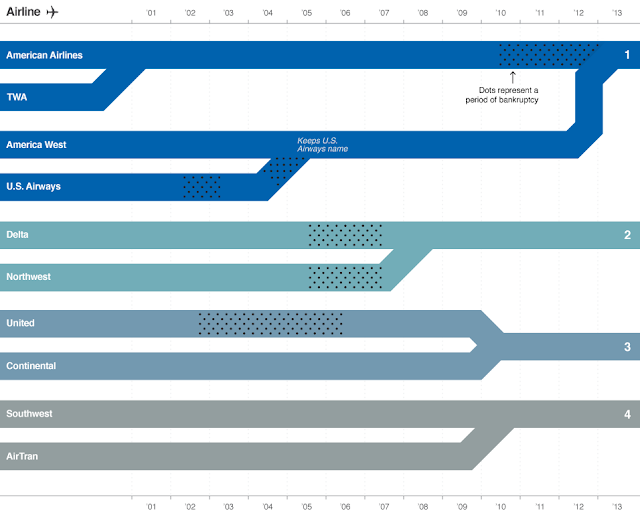
Airline Mergers - Visualized
From CNN (Yes. CNN. Go figure.)
Its simple, direct, and depressing.
Sigh.
(Click to embiggen. A lot)
Its simple, direct, and depressing.
Sigh.
(Click to embiggen. A lot)
Thursday, February 14, 2013
50 states - each w/ the same population - Visualized
Neil Freeman at Fake Is The New Real takes on Electoral College Reform by redoing the state boundaries to make sure that they are all equi-populous (if that is a real word...)
From the post
From the post
Wondering about the details of the implementation?Advantages of this proposal
- Preserves the historic structure and function of the Electoral College.
- Ends the over-representation of small states and under-representation of large states in presidential voting and in the US Senate by eliminating small and large states.
- Political boundaries more closely follow economic patterns, since many states are more centered on one or two metro areas.
- Ends varying representation in the House. Currently, the population of House districts ranges from 528,000 to 924,000. After this reform, every House seat would represent districts of the same size. (Since the current size of the House isn't divisible by 50, the numbers of seats should be increased to 450 or 500.)
- States could be redistricted after each census - just like House seats are distributed now.
Disadvantages
- Some county names are duplicated in new states.
- Some local governments would experience a shift in state laws and procedures.
The map began with an algorithm that grouped counties based on proximity, urban area, and commuting patterns. The algorithm was seeded with the fifty largest cities. After that, manual changes took into account compact shapes, equal populations, metro areas divided by state lines, and drainage basins. In certain areas, divisions are based on census tract lines.The District of Columbia is included into the state of Washington, with the Mall, major monuments and Federal buildings set off as the seat of the federal government.The capitals of the states are existing states capitals where possible, otherwise large or central cities have been chosen. The suggested names of the new states are taken mainly from geographical features:
- mountain ranges or peaks, or caves – Adirondack, Allegheny, Blue Ridge, Chinati, Mammoth, Mesabi, Ozark, Pocono, Rainier, Shasta, Shenandoah and Shiprock
- rivers – Atchafalaya, Menominee, Maumee, Nodaway, Sangamon, Scioto, Susquehanna, Trinity and Willimantic
- historical or ecological regions – Big Thicket, Firelands and Tidewater
- bays, capes, lakes and aquifers – Casco, Tampa Bay, Canaveral, Mendocino, Ogalalla, and Throgs Neck
- songs – Gary, Muskogee and Temecula
- cities – Atlanta, Chicago, Columbia, Detroit, Houston, Los Angeles, Miami, New York, Newark, Philadelphia, Phoenix and Washington
- plants – Tule and Yerba Buena
- people – King and Orange
Tuesday, February 12, 2013
Spreadsheets - Seriously Risky!
You've all heard of The London Whale, right? The dude(s) at J.P. Morgan's Chief Investment Office in London who managed to lose $6 Billion on botched investments?
The gory details on what happened are out, and they are dry - seriously dry - reading. But there is one part that stands out - the role of spreadsheets in all this.
From FT Alphaville -
You pretty much know where this is leading, right?
Turns out that this was a key part of the franken-sheet, that was responsible for telling them how risky their investments were (larger was worse)
And they divided the number by the sum instead of the average.
Like I said, Brilliant!
We really, really are doomed.
On that note, its worth pointing out that there is an organization called The European Spreadsheet Risk Interest Group, which - you guessed it - deals with spreadsheet related risk management.
Mind you, the very fact that something like this exists is deeply frightening to me.
Regardless, their list of horror stories is informative, and should cause you to lose no little amount of sleep.
Examples include
Mouchel -->
The gory details on what happened are out, and they are dry - seriously dry - reading. But there is one part that stands out - the role of spreadsheets in all this.
From FT Alphaville -
[...] the model operated through a series of Excel spreadsheets, which had to be completed manually, by a process of copying and pasting data from one spreadsheet to another[...]Yeah, you got that right. Our Financial Overlords use Excel and copy/paste in their overlord-ian activites. (We are so doomed)
You pretty much know where this is leading, right?
an operational error in the calculation of the relative changes ... [s]pecifically, after subtracting the old rate from the new rate, the spreadsheet divided by their sum instead of their average, as the modeler had intended.Brilliant.
Turns out that this was a key part of the franken-sheet, that was responsible for telling them how risky their investments were (larger was worse)
And they divided the number by the sum instead of the average.
Like I said, Brilliant!
We really, really are doomed.
On that note, its worth pointing out that there is an organization called The European Spreadsheet Risk Interest Group, which - you guessed it - deals with spreadsheet related risk management.
Mind you, the very fact that something like this exists is deeply frightening to me.
Regardless, their list of horror stories is informative, and should cause you to lose no little amount of sleep.
Examples include
Mouchel -->
Morgantown -->An accounting error yesterday forced outsourcing specialist Mouchel into a major profits warning and sparked the resignation of its chief executive.Richard Cuthbert stood down as analysts warned the firm was in danger of breaking banking agreements on debt after it had to reduce full-year profits by more than £8.5million to below £6million.The mistake was not Cuthbert’s, however, but an outside firm of actuaries. It told the company on Wednesday that a spreadsheet error meant a pension fund deficit had been wrongly valued. As a result, Mouchel had to write down profits by £4.3million.
Nevada -->Morgantown City Clerk Linda Little said a computer error led to a discrepancy in vote totals for council candidate George Papandreas.The candidate -- who was defeated by incumbent Ron Bane -- actually received 99 more votes than was originally indicated in the total ..Little said election officials had put the total number of votes for each precinct into a Microsoft Excel spreadsheet. The computer program skipped over an entry when it added the totals, she said.
The Nevada city budget spreadsheet apparently worked correctly until sometime in late December 2005 when, city finance director Ron Chandler says, it developed a problem, causing the 2006 budget to show a $5 million deficit in the water and sewer fund. Chandler said that it took him most of the day Wednesday to fix the problem. While he was working on it he found some other errors in the spreadsheet that needed to be correctedAnd the list goes on. Go check out the original
What Database Do You Need?
From C.R.U.D. comics. (Comics Regarding Unpopular Databases)
Money quote --> "Technology must remain compelling, lest it make us complacent".
Hat tip Alex Popescu
Money quote --> "Technology must remain compelling, lest it make us complacent".
Hat tip Alex Popescu
Speaking the truth to...Food
Ryan Sohmer and Lar DeSouza nail one of life's essential truths.
Mind you, they didn't quite grasp the intrinsic awesomeness that are Trader Joe's Chocolate-covered peanut-butter pretzels.
Monday, February 11, 2013
License to steal...
“The greatest triumph of the banking industry wasn’t ATMs or even depositing a check via the camera of your mobile phone. It was convincing Treasury and Justice Department officials that prosecuting bankers for their crimes would destabilize the global economy.”
-Barry Ritholtz
Source The Daily Beast
Wednesday, February 6, 2013
The Mustache Of Understanding strikes Again!
Will someone please make him stop?
Do you think he might just go away if we ignore him?
Or maybe we can pay him to leave?
I've said this before, but its worth repeating - the dude just uses pretty damn much any random factoid that he encounters, whether true or false, as ballast for whatever bullshit point he is trying to make.
All the time.
Every time.
Exhibit A - his latest column, where he is trying to draw some sort of equivalence between India, China, and Egypt.
He could have gone with a Standard Freidmanism™ something like "The shared history of these countries dates back to the river-valley civilizations 25,000 years ago" or some such bullshit.
But nooo, he goes one better, and basically makes something up out of whole cloth (emphasis mine)
Egypt - yes. India - yes. But China? China of the aging population? China with the one child policy?
Has The Mustache ever used Teh Googles?
Does he even know how to?
If he did, he would have ended up at PopulationPyramid.net, (or this, or this, or, well, whatever, you get the point) where he would have fund the wonderful chart to the left.
See the awsome "youth bulge under the age of 30"? The one that is actually at 40 - 60? With the peak at 45 - 50?
Youth bulge my ass.
No wonder he won the One True Wanker Of The Decade award...
Do you think he might just go away if we ignore him?
Or maybe we can pay him to leave?
I've said this before, but its worth repeating - the dude just uses pretty damn much any random factoid that he encounters, whether true or false, as ballast for whatever bullshit point he is trying to make.
All the time.
Every time.
Exhibit A - his latest column, where he is trying to draw some sort of equivalence between India, China, and Egypt.
He could have gone with a Standard Freidmanism™ something like "The shared history of these countries dates back to the river-valley civilizations 25,000 years ago" or some such bullshit.
But nooo, he goes one better, and basically makes something up out of whole cloth (emphasis mine)
India has a weak central government but a really strong civil society, bubbling with elections and associations at every level. China has a muscular central government but a weak civil society, yet one that is clearly straining to express itself more. Egypt, alas, has a weak government and a very weak civil society, one that was suppressed for 50 years, denied real elections and, therefore, is easy prey to have its revolution diverted by the one group that could organize, the Muslim Brotherhood, in the one free space, the mosque. But there is one thing all three have in common: gigantic youth bulges under the age of 30, increasingly connected by technology but very unevenly educatedOh, really?
Egypt - yes. India - yes. But China? China of the aging population? China with the one child policy?
Has The Mustache ever used Teh Googles?
Does he even know how to?
If he did, he would have ended up at PopulationPyramid.net, (or this, or this, or, well, whatever, you get the point) where he would have fund the wonderful chart to the left.
See the awsome "youth bulge under the age of 30"? The one that is actually at 40 - 60? With the peak at 45 - 50?
Youth bulge my ass.
No wonder he won the One True Wanker Of The Decade award...


.jpg)