Thursday, January 31, 2013

Remittances from Migrants - Visualized

Yet another gorgeous Visualization from The Guardian - showing the flow of money from migrants (in the form of remittances) worldwide. (Note that the above is just the image - for the interactive version, go to the source)
As The Guardian puts it
Migrant workers have always sent money home to support family and friends. But in recent years these remittances, as they are known, have reached record highs.
Officially recorded remittances are thought to have topped $500bn last year. But the World Bank estimates that the true figure, including unrecorded and informal channels, may be higher still.
Government data rarely includes details on where remittances end up, and it's difficult to determine how much money being sent from Switzerland comes directly from migrant workers and how much is being routed through Swiss banks.
The World Bank's Migration and Remittances Unit, led by Dilip Ratha, has tried to estimate the true size and direction of global remittance flows. This interactive uses the World Bank's new estimates for 2011 to map where remittances come from, where they go, and how important they can be for some of the world's poorest countries.
Go check it out!

Tuesday, January 29, 2013

Behavioral Economics - Visualized

via The Globe and Mail, we get this comprehensive (and accurate!) Infographic.  Seriously, This is your brain on Behavioral Economics (click to embiggen quite a bit)


James Bonds - Visualized

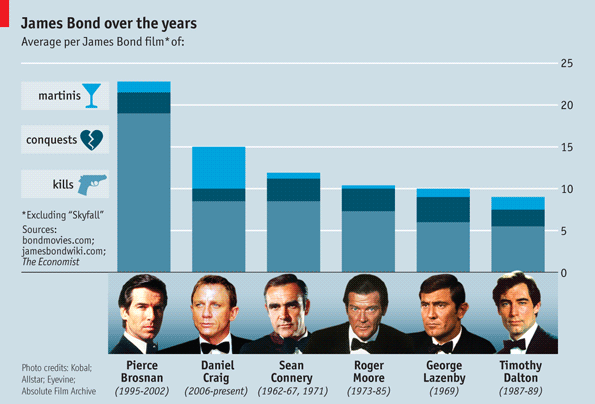
via The Economist, this chart rating the various Bonds based on Booze, Babes, and Bloodthirstiness (ah alliteration, how I love thee)
It appears that Pierce Brosnan was - by far - the one with the most kills.  Who would-a thunk it?

NFL FIeld Goals - Visualized

From Decision Science News, comes this little bit of awesomeness regarding field-goals.
They took all 10,705 of the field goals in the NFL from 2002 - 2012, and it basically came out to the following
  • At D > 50 yards, you make the Field Goal with probability 0
  • At D < 50 yards, it is 0.951 + .0062*D - 0.005*D^2
Mind you, the other thing I found fascinating was that the coaches not only know this, they pretty much live by this too - with them basically not even bothering at  D > 50
Check out the original!


Monday, January 28, 2013

Sooo tired....


Sunday, January 27, 2013

Why I've grown to loathe C

Ever since I stopped using C as my primary / go-to language (currently erlang and perl, but including pascal, smalltalk, java, lisp, and eiffel at times) I've always had this vague hatred of it, but its always been hard to quantify, with any attempts to discuss this usually being met by responses that were inevitably fanyboish, both pro, and against.

Witness Damien Katz's recent - and unintentionally hilarious - Unreasonable Effectiveness of C, and its followup (no, I'm not going to fisk them - read them, preferably not while drinking anything to avoid spit-takes).  It pretty much sums up the fanboy position for any language, best summarized as
  1. Take everything that matters to the project you are currently working on
  2. Explain why your preferred language is the single best language to implement whatever it is
  3. Hint that pretty much everything else doesn't even come close
  4. Throw in a grab-bag of other random features that - of course - your language does best
  5. And for bonus points, pull a Karl Rove and claim that a few well known weak points are actually strengths (buffer overflows are useful! They help identify security threats! Also puppies! And kittens!)
Debating inane points being somewhat anathema to my existence, I've pretty much stayed far away from these discussions, and my C-uneasiness has stayed exactly that, a vague feeling of uneasiness apparently destined to remain unfulfilled.
All this, until Dr. Rustom Mody came to the rescue - his brilliant C in Education and Software Engineering is the definitive answer to the canker-sore that is C (to me at least...)
Just go read it - it sez everything that I want to say (but just a lot, lot better).
An excerpt from Section 5 - Consequences of C as a mother-tongue
The harm done by an overly early introduction to C is large although invisible. C-mother-tongue programmers are life long bound to find simple, elegant yet wonderfully rich ideas like Object Oriented Programming, functional programming, modularity, CSP etc. as difficult, unnatural and ‘advanced’. If these claims seem like exaggerations, it is only because of human beings’ ability to unlearn. The amount of stuff which a C programmer knows, but subsequently must be discarded as being operational, machines-pecific, implementation-specific, sequential-paradigm specific, contrary to robust software engineering etc., is incalculably large.

Just as a C programmer finds it difficult to grow upwards towards more high level languages, he finds it difficult to grow downwards as well. Experience with engineers (B.Techs) who are first trained on hardware, suggests that an assembly language programmer can learn C much faster than conversely. Surprisingly, an assembly language programmer can also learn higher level languages (eg. functional and object oriented) more easily than expert C programmers. The reasons seem to be that
  1. Assembly language programmers are acutely conscious about the drudgery that low level programming entails. C programmers however have a persistent illusion of working in a higher level language.
  2. The assembly language programmer has a firm foothold on computational processes even if his/her understanding is entirely operational.
 There is more, much more. Go read the whole paper - its worth your time...

Saturday, January 26, 2013

Elevators and Erlang

From a recent post by Robert Virding on erlang-questions
What is it with zero-based indexes that make people so morbidly fascinated by them. If you are talking *offsets* then I agree that zero-based is fine, it's saying how far away something is from a some point. But here we are talking *indexes*, you know like first, second, third, etc. No indexes start at one! And don' go on about how C does it because C doesn't have arrays and indexes it has pointers and offsets, foo[3] is just syntactic sugar for *foo+3. And don't go on about how much easier it is to count from zero, I don't buy that, we can all add and subtract one without problems. Or at least I hope so.
In this vein, I would like to point out that Elevators in America subscribe to this basic philosphy, and are, indeed, 1-based.
This compares extremely favourably to those pesky Europeans that have G-based indexing.
G?
Seriously? 


The Periodic Chart of Football Players

The Guardian's list of the world's best football players has been converted to a Periodic Table by OnASixpence.
(Shocker - Messi at #1)

California for Beginners - Visualized

A remarkably accurate take on California, for all those not (fortunate enough to be?) from California.
Hat-tip ChartPorn

Thursday, January 24, 2013

Learn to be a Central Banker (in 10 easy steps)

This via Barry Ritholz @ The Big Picture

Learning to Be A Central Banker in 10 Easy Steps
Start with one policy – for example – interest rates. Place the policy ball in your right hand and begin by lowering rates. which causes the ball be tossed-up into the air, in an arc, and land in your left hand. Note how, when the policy ball is in your left hand and you raise rates, the ball returns in an arc to your right hand. Repeat several times to get the feel. (Note this doesn’t work if you are left-handed)

Now with he first policy ball in your left hand, take a second policy ball in your right hand, say the value of the US dollar. Notice how when you lower interest rates while the PBoC, and other official buyers in BRICs and GCC countries buy Long Bonds, the 2nd policy ball, the Dollar, feels heavy as if it wants to fall to the ground. Exerting appropriate pressure, you must force it up to arc, after which it should fall back down landing in the left hand.

Now with interest rates in your left hand, and the FX value of the dollar in your right hand, try to toss the rates lower, and as they arc downwards, you will need to jettison the dollar. Be certain to avoid the common mistake of throwing up rates too high if the dollar is NOT falling.
After letting the dollar fall for a while (note the nice concave arcing pattern in the picture), you will need to catch it with your right hand firmly by attempting to pay some lip-service to a strong-dollar policy. This permits the official entities who are at once your friends and your enemies, to get off the hook by buying dollars under the premise that you do care about its value.
Warning: Under no circumstance should you allow the policy balls to collide by lowering rates AND letting the dollar fall. Or else you might ultimately have to raise rates, making the introduction of the 3rd policy ball very difficult.

Get the hang of things by practicing tossing the two balls, raising and lowering interest rates as required, and jawboning (and where necessary) letting the dollar fall to floor. See if you do this while reciting Humphrey-Hawkins-like testimony, and answering your wife’s questions.
Now quickly, you will find a third ball in your hand whether your ready for it or not, for as rates have been raised to pay lip service to inflation and the falling dollar, the third ball, economic growth, needs to be tossed into the air. Be careful NOT to make the common mistake of walking in circles while juggling the balls.

Irrespective of how high you toss it, will begin arcing lower as the economy begins to falter. Just before you catch the falling economy with your left hand, you will have thrown the rates ball back your right, while the dollar accelerates its decline towards your left, such that you can start all over again. It is essential to avoid changing the policies in a staggered rhythm.
As the economy climbs back on its arc to your right, you will be catching interest interest rates with your left, having sent the dollar on a stronger trajectory with your right, before repeating the exercise. Be sure not to launch the interest rate ball too high or too far in front of you.

Congress at this point will be demanding that you pay the most attention to the economy ball, so you must learn to turn your back (on them), and see if you can juggle behind your back as in the diagram (right).
CONGRATULATIONS! You are now ready to set monetary policy for the largest economy in the world!!
NEXT WEEK: In your next lesson we’ll introduce balls 4 and 5 in the form of a sub-prime crisis, and banking system solvency issues, just for fun!

Tuesday, January 22, 2013

The "anti-loneliness" Ramen Bowl

For all those people who abhor eating their Ramen by themselves, we have, this, the anti-loneliness Ramen Bowl from MisoSoup design.
I really don't have all that much to add to this, other than
  • The ramen looks good, and
  • Whats wrong with eating ramen by yourself?
Apparently I'm missing something...

The Paige (2002 - 2013)


Her name was Paige, and she spent nine years with us.
Nine glorious, wonderful years that ended last night when we had to put her to sleep.
I can't summarize what she meant to us - it would take too long - she was simply "The Paige", and we loved her.
I miss her already.


Monday, January 21, 2013

Inaugural Speech Lengths - Visualized

Matt Stiles @ NPR puts together the definitive chart on Inaugural Speech lengths (also, quite possibly, the only such chart, but whatever).
Soooo, whats up with W. H. Harrison?

The United States of Paranoia

Via Jack Ohman
(hat-tip Barry Ritholz)

Saturday, January 19, 2013

Assassination attempt in Bulgaria


Ahmed Dogan (leader of the Movement for Rights and Freedom, and now the leading opposition party candidate in Bulgaria) just - barely - escaped an assassination attempt when the assassin's gun misfired.
As the video above shows, Mr. Dogan then knocked the gun out of the way and (briefly) tackled the assassin before secret service stormed the stage.
Unreal.
Seriously Unreal


Thursday, January 17, 2013

Die Hard - The Inforgraphic

From Latino Review, we have what you have been waiting for - a Die Hard infographic.
19 characters with moustaches?
39 F**ks?
Who knew!
Incidentally, did you know that there was actually a Die Hard 4 at some point? W/ that annoying "I'm a Mac" guy? Urghk...
(click to embiggen...)


Wednesday, January 16, 2013

Time to shut the WSJ down? (Income Insanity Edition)

Herewith a brilliant article in the WSJ (ostensibly a "news"paper), which talked about all the Back door tax increases associated with the fiscal cliff fun-ness at the end of 2012.
I'm not really going to get into this, 'cept to highlight an image that was included with the article

A copy of the image is shown above.  I highly recommend that you click on it to embiggen, and take a good long stare at it.  Please do not laugh uncontrollably.  Or cry.  Both reactions are possible...
(Also, do remember that the median household income in the U.S. is $50,100)

See all those sad people?
They're all clearly sad because their taxes are going up.
Especially the single mom in the top-left, the one w/ the two kids and the $260,000 income
Which is exactly like all the other single-moms out there, especially the ones with two kids, as long as they are making 5.18 times the median income!

And the married couple on the bottom right, the ones with four kids and a $650,000 income.
Which is exactly like all the other families out there, especially the ones with four kids, as long as they are making 12.97 times the median income!

I'm not even going to get into the single person w/ the $230,000 income.
But, on an incidental note, why is the retired couple wth $180,000 income on the top right unhappy?
I mean, their taxes are not going up, and they are making 3.59 times the median income!

Maybe I have it wrong.  Maybe the WSJ has been taken over by The Onion...

The Power of Selling Out (as The Onion takes on TED)

The Onion Talks brings you The Power of Selling Out: Your Customers as Political Capital - yet another gorgeous take-down of TED talks.
From the description
Nathan Eslinger has spent his career designing cutting-edge websites, like his extremely popular photo sharing platform Ripple. While advertising can produce revenue, Eslinger has found a far more profitable and immediate way to generate income: selling his users' data to oppressive governments.


Climate Change - Visualized

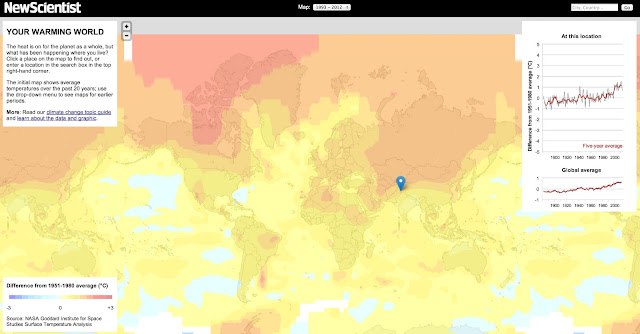
New Scientist has put together one of the best visualizations on Global Warming that I've seen
You really should play around with this.  You can
  • Pick a 20 year period to look at global trends in that period - from 1893 to 2012
  • Pick a location to look at the specific trend in that location
  • Drill down into a specific area
There is a whole lot more - it really packs a ton of information into a clear and intuitive interface.   (The above is just a screen grab.  Go to the original for the Visualization

From the writeup on the site
This interactive graphic displays results from a global analysis of surface temperatures from 1880 to the present called GISTEMP, produced by a team at NASA’s Goddard Institute for Space Studies in New York City.

The graphs and maps all show changes relative to average temperatures for the three decades from 1951 to 1980, the earliest period for which there was sufficiently good coverage for comparison. This gives a consistent view of climate change across the globe. To put these numbers in context, the NASA team estimates that the global average temperature for the 1951-1980 baseline period was about 14 °C.

The analysis uses land-based temperature measurements from some 6000 monitoring stations in the Global Historical Climatology Network, plus records from Antarctic stations recorded by the Scientific Committee on Antarctic Research. Temperatures at the ocean surface come from a measurements made by ships from 1880 to 1981, plus satellite measurements from 1982 onwards.

Surface temperature measurements are not evenly distributed across the globe. So the NASA team interpolates from the available data to calculate average temperatures for cells in a global grid, with each cell measuring 2 degrees latitude by 2 degrees longitude. The analysis extrapolates up to 1200 kilometres from any one station, which allows for more complete coverage in the Arctic – where monitoring stations are sparsely distributed, but where the warming trend is especially strong.

The NASA team also corrects the data to remove local heating caused by dense human settlements – a phenomenon known as theurban heat island effect. Temperature stations in urban areas are identified by referring to satellite images of the light they give off at night, and their records are adjusted to reflect the average trend of nearby rural stations.
The global picture is frightening enough, but there is some really bad shit going on at the poles...


Air pollution worldwide - Visualized

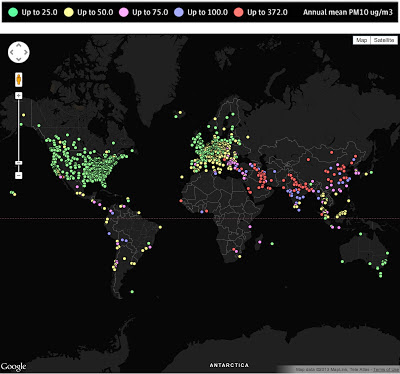
The Guardian took WHO's data on air pollution across the world and created a pretty nifty interactive mashup (using Google, of course).
You can drill down to quite some detail, but IMHO, the "global" view is much more striking.  There is really not that much good news from India and China, but the middle-east's numbers are really quite striking (and depressing).
These are just screen-grabs, go to the original for the full mashup...

Tuesday, January 15, 2013

Flipping the Bird - in photographs since 1886!

Retronauts has what could very well be the first recorded image of someone flipping the bird. 
Its from 1886, and its Charles Radbourn of the Boston Beaneaters.
I guess it beats the heck out of a Patel snap.  Then again, one wonders what the first occurence of that one was...

Monday, January 14, 2013

Interactive Subway Maps - an origin-centric approach

 Jerome Cukier has put together a radically different take on the Paris Subway map, making it more origin-centric, and giving you a much better picture on how long the trip will take.
The image above is your default Paris Subway Map, which - as always - gives you a surprisingly large amount of information.  But, clicking on any given station reorients the entire map to center it on that station as follows

e.g., clicking on Saint-Lazare makes it the center of the subway map - one presumes that you actually want to figure out how to get somewhere from Saint-Lazare :-)
As a last step, hover on a given station (say Alésia) and you see the route there from Saint-Lazare
From Jerome's description
     So when a user selects a station, the rest of the network moves according to their (shortest path) distance to the selected station. So at the heart of the exercise there is a shortest path calculation from any station to any other. Including stations, platforms, connections, entrances and exits, that’s a network of 680 nodes and 1710 edges (for 299 stations, I didn’t include a couple of the very last ones). And it’s a directed network, because there are some sections which go in only one direction. At most, a network that big could have close to 500,000 edges, so it’s fairly sparse.
     There are several algorithms to compute shortest paths in the code. I am using the best known one, Dijkstra, which works on path with no negative edge length. The way it is implemented here, with binary heaps, makes it so fast that it’s not noticeable. Not using that improvement, or relying on a more versatile but slower shortest path algorithm, would result in considerably greater computing times.
Brilliant work indeed.  Go and play with the actual interactive map...
 

Sunday, January 13, 2013

Damned if you do, damned if you don't

Saturday, January 12, 2013

The Database Landscape - Visualized

Matthew Aslett has an updated version of the database landscape chart that he had put together a while back - done in hardcore London Underground style (and it is the better for it).
Check it out (click to embiggen...)

Friday, January 11, 2013

How Gandalf Solves Problems

The LOTRProject has the last word on Gandalf's problem solving abilities.
(hat-tip Nathan Yau)


Frightening statistic of the day - Incarceration Rates

From Invisible Men: Mass Incarceration and the Myth of Black Progress by Becky Petit.
Five percent of white men and 28 percent of black men  born between 1975 and 1979 spent at least a year in prison before reaching  age thirty-five. The risks of spending time in prison for this birth cohort were  significantly higher among high school dropouts: 28 percent of white and 68 percent of black dropouts had spent at least a year in prison by 2009
(emphasis mine).  If this doesn't give you pause, well, it should.
But wait, it gets worse.  Check out the following stats
  • > 1% of American adults is living in prison
  • >3% of American adults is under some form of correctional supervision  (probation, parole, etc.)
  • Shortly, >30% of black men will have served time in prison
Keep those numbers in mind as you walk around today. And remember, this isn't happening in "that bad neighborhood over on the other side of the tracks", its happening everywhere. We are incarcerating people at a rate unequaled in history, and the sheer numbers are mind-boggling.

28% of whites and 68% of black dropouts have spent at least a year in prison

This is all around you.  This is America today. 


The power of Marketing compels you!

To buy useless crap because Its Shiny! and It has Formula T25 in it! and Kim Kardashian uses it!
Then again, once you actually realize this, you start seeing the messages everywhere, driving you to either drink, suicide, or a cynical hatred of mankind...
Jonathan Rosenberg does this proper...

Wednesday, January 9, 2013

Colbert on the Platinum Coin Solution

Les Misérables - Visualized

Jeff Clark (@ Novel Views) put together a visualization showing where the main characters are mentioned in the text, and their mood at that point (Red is "negative", Blue is "positive").
Given that there seems to be a lot or red up above,it looks like, Les Misérables is, well, kinda depressing.
I know, shocking, right?
(Oh, you can click the above image to embiggen it. A lot)

Visualizing Images - through Words

Creating an image out of a word, using only the letters, and nothing else - brought to you by Ji Lee


For example