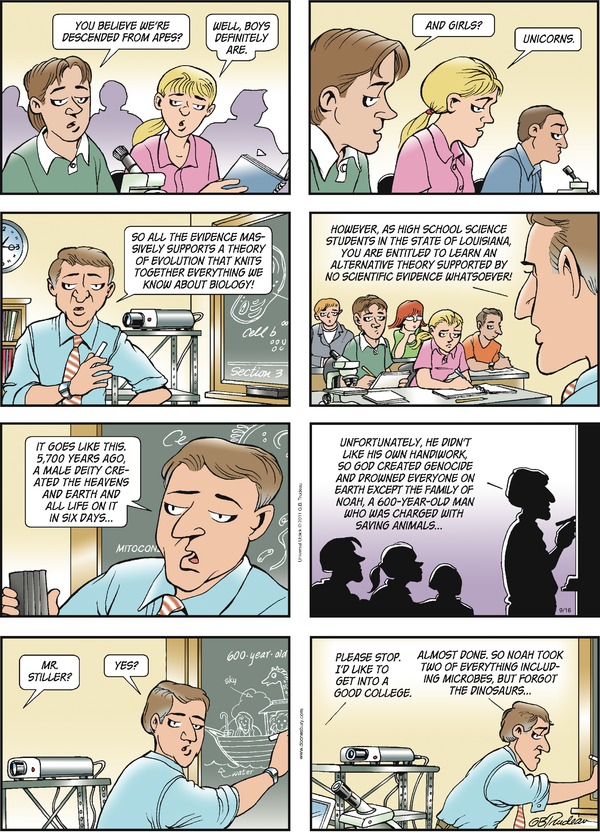
From SMBC, we have the clearest depiction of the difference between Normal and Economist type humans that I have seen in quite a while.
(Zach Weiner is a genius...)
Random comments on Economics, Edibles, Erlang and Life
For those of you who didn't feel like reading through all of that, it basically boils down to the followingRegarding increased CPU utilization in R15. When schedulers run out of work, they busy wait for a while before going to sleep. Waking up a busy waiting thread is much faster than waking up a sleeping thread. Due to the rewrites of memory allocation in R15, schedulers are more frequently woken, which cause more busy wait, which in turn cause an increase in CPU utilization when schedulers frequently run out of work (you will at least see some decrease of CPU utilization due to this in R16). When not running out of work there will be no busy wait at all. That is, the increase in CPU utilization does not translate into loss of performance. The busy waiting is there since it shortens the average time to wake up a scheduler, and by this reduces average communication latency between processes. Depending on application the reduced latency might also translate into improved throughput. If the increase in CPU utilization is unwanted, one can as of R15B02 shorten the busy wait threshold (+sbwt command line argument). Note that by shortening the busy wait threshold, there will be an increased average latency.
So yeah, you can lower the wait time before the scheduler goes to sleep, thus reducing your electricity bill, at the cost of increasing the response time when a new process comes along.
+sbwt none|very_short|short|medium|long|very_long
Set scheduler busy wait threshold. Default is medium. The threshold determines how long schedulers should busy wait when running out of work before going to sleep.
"I say to the grownups, 'If you want to deny evolution and live in your world that's completely inconsistent with everything we've observed in the universe that's fine. But don't make your kids do it."Because, seriously, if you insist on raising your kids to be morons, Who is going to take care of you when you get old?
[...]"We need them. We need scientifically literate voters and taxpayers for the future."
MySQL is what you get when application developers build an RDBMS.This isn't really flame-bait - its intended as a statement to show how people approach arguments (flame wars?) about MySQL vs PostgreSQL. To paraphrase Chris,
PostgreSQL is what you get when database developers build an application development platform.
MySQL is what you get when application developers build an RDBMS.MongoDB has a great GUI, the documentation is spectacularly good, the API is pretty neat (OK, from a RoR perspective), and 10gen has great marketing, but the Design Decisions underlying the database? Boy Howdy, are those entertaining - and not in a good way.
PostgreSQL is what you get when database developers build an application development platform.
MongoDB is what you get when GUI developers build an RDBMS.
Got that?Many people find speed cameras frustrating, and some in the region are taking their rage out on the cameras themselves.But now there's a new solution: cameras to watch the cameras.One is already in place, and Prince George's County Police Maj. Robert V. Liberati hopes to have up to a dozen more before the end of the year.
Speed cameras themselves can't be used for security because under Maryland law speed cameras can only take pictures of speeding, says Liberati.The sheer insanity of this whole process is mind-boggling. Me, i'm waiting for when they put up cameras to monitor these cameras :-)
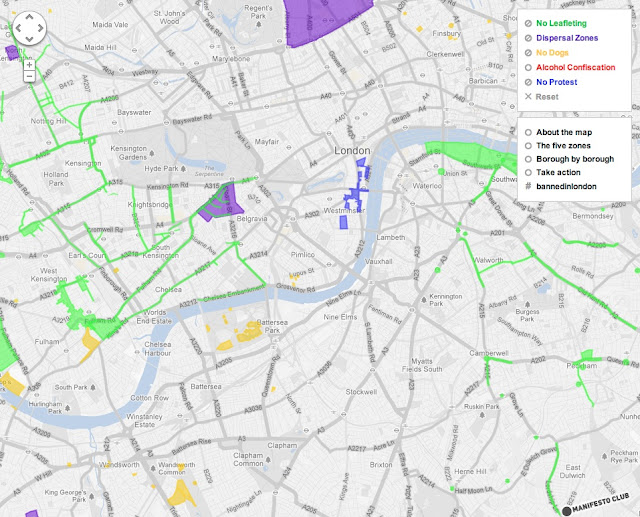
Go to the actual interactive map, the below is just an image...You are in danger of unwittingly committing an offence if you stray into one of 435 special zones in London. The boundaries of these zones are often unmarked and within them many everyday activities are either banned or restricted.A new Manifesto Club online Google map, Banned in London, reveals the 435 special zones that now cover half the area of the UK capital.In these areas, people can be fined or prosecuted for activities that would not otherwise be an offence - including leafleting, protesting, dog walking, gathering in groups, and drinking in public.
So yeah, the bottom line (to the bottom line) is that if you care about reducing the size of government spending (Yes! You! I'm talking to you, who is so clearly frothing at the mouth about this, even though Austerity Now! Austerity Forever! is destroying economies all around), you want to vote for a Democrat as President. Because they clearly do better, and the Republicans, even more clearly do worse.
To replace Mom, young adults need to form new relationships. Close friends. Romantic partners, and eventually a spouse (which in turn leads to kids, another motivator). But it is very difficult to form these relationships fast (which you need to do in order to start a career fast) without sacrificing quality; if you're just randomly searching, it takes a long time to find friends and a lover who really click with you, especially if you're a smart person who clicks best with other smart people.Me, I think Noah Smith is right, but SMBC is, definitely, funny :-)
This is where college comes in. College is an intense incubator where smart people meet other smart people. The large number of leisure activities and the close quarters in which people live facilitate the formation of friendships and romantic relationships, while the exclusiveness of college makes sure that the people you're meeting are pre-screened to be the type of people with whom you are most likely to click. In the U.S., the "college experience" includes parties, trips, clubs, athletic events, religious fellowships, communal drug use, study groups, endless late-night conversations, and more esoteric events like the one pictured above. In Japan, it includes "go-kon" (group blind date) parties, "nomikai" (pub nights), and clubs. American college works better, but it's much the same sort of thing.
Second, there is "perspective". This is about learning the set of possibilities for life. Before I went to college, I never knew people who went into the finance industry, or joined tech startups, or worked for the World Bank, or did sound engineering for movies, or taught English in foreign countries. In college I met people who did all of the above, and seeing them taught me a lot about the set of possibilities for human life. Simply knowing one's career choice set is a hugely important part of choosing the right career. And it's surprisingly hard to do. College is a great way to gain career and life perspective; if you go from high school straight to the workforce, you are basically assured of not meeting as diverse a group of high achievers.
Finally, there are the human networks built by college. I won't talk a lot about this, because other people have done so quite a lot, and there are a bunch of scientific papers about it. And it's pretty obvious, just from looking at MBA programs, which cost more than college and are well known to be all about professional networking. (Note: As a commenter points out, this is actually called "social capital".)
Words fail me...Cereality® is more than a place to get cereal. It's a new way of thinking about cereal. A new choice in fast food. And an idea whose time has come.At Cereality, customers choose from their favorite brands and toppings. Pajama-clad Cereologists™ fill the orders. And customers choose and add their own milk, just the way they like it
CARNEY: What role should government have in promoting certain industries or economic activities such as homeownership, or manufacturing, renewable energy or fossil fuel energy, exports, or just advanced technology? What sort of subsidies and incentives do you favor? You had some of these in Massachusetts, I know.Mind you, if you listen to the video, he - kinda, sorta - chuckles, but this is still seven levels of Awesome...
ROMNEY: Very limited -- my answer to your first question. I’m not an advocate of industrial policy being formed by a government. I do believe in the power of free markets, and when the government removes the extraordinary burdens that it puts on markets, why I think markets are more effective at guiding a prosperous economy than is the government.So for instance, I would not be investing massive dollars in electric car companies in California. I think Tesla and Fisker are delightful-looking vehicles, but I somehow imagine that Toyota, Nissan, and even General Motors will produce a more cost-effective electric car than either Tesla or Fisker. I think it is bad policy for us to be investing hundreds of millions of dollars in specific companies and specific technologies, and developing those technologies.I do believe in basic science. I believe in participating in space. I believe in analysis of new sources of energy. I believe in laboratories, looking at ways to conduct electricity with -- with cold fusion, if we can come up with it. It was the University of Utah that solved that. We somehow can’t figure out how to duplicate it.
The transportation or importation into any State, Territory, or possession of the United States for delivery or use therein of intoxicating liquors, in violation of the laws thereof, is hereby prohibited.Or, to put it really simply, States can do whatever the hell they want vis-a-vis Wine (and other alcoholic beverages). Ordering Kitty-litter across state lines is OK, but wine is verboten.
Representatives and direct taxes shall be apportioned among the several states which may be included within this union, according to their respective numbers, which shall be determined by adding to the whole number of free persons, including those bound to service for a term of years, and excluding Indians not taxed, three fifths of all other Persons.If it wasn't for the 14th amendment....